


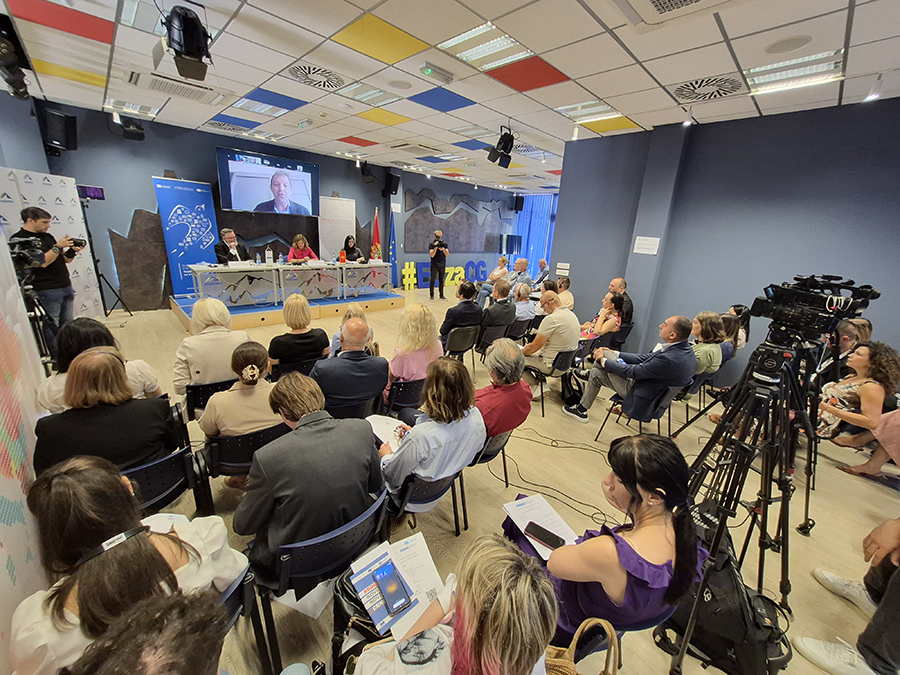
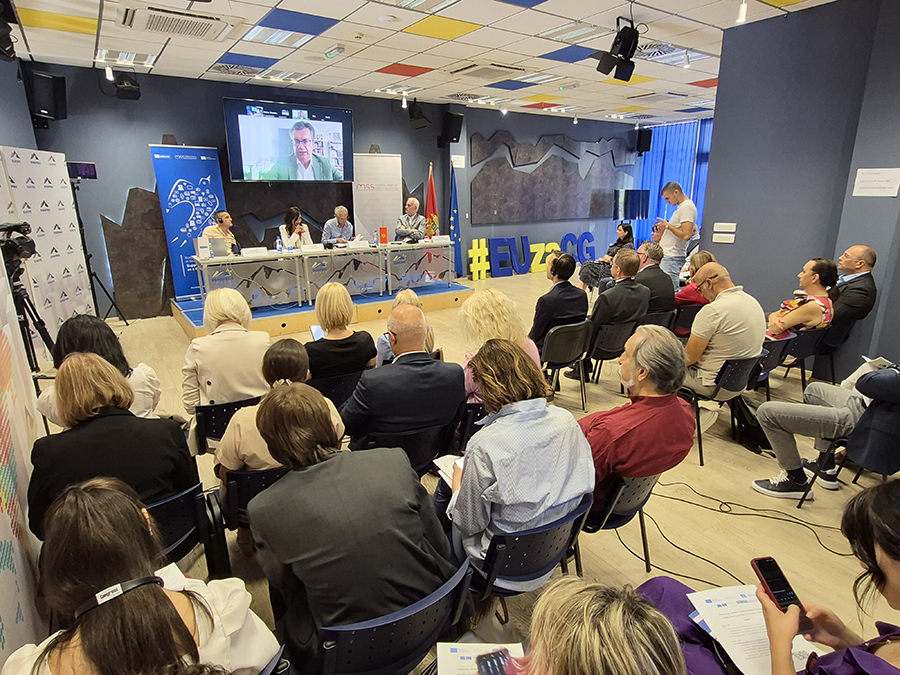
The revised version of the Code of Ethics of Journalists of Montenegro was presented today in Podgorica.
The working group, composed of representatives of the Media Council for Self-Regulation and the media ombudsmen and ombudswomen of Dan, Vijesti, Monitor and RTCG, has developed a number of practical tools for journalists in the past few years.
It included the creation of several manuals, namely on: moderating online comments, reporting on hate speech, monitoring election campaigns, countering misinformation and disinformation, as well as on artificial intelligence and social networks. These manuals initiated and shaped many new provisions in the proposed amendments to the Code of Ethics of Montenegrin Journalists.
The head of the mission of the Organization for Security and Cooperation in Europe (OSCE) in Montenegro, Jan Haukaas, pointed out that the working group played a central role in the drafting of amendments to the Code.
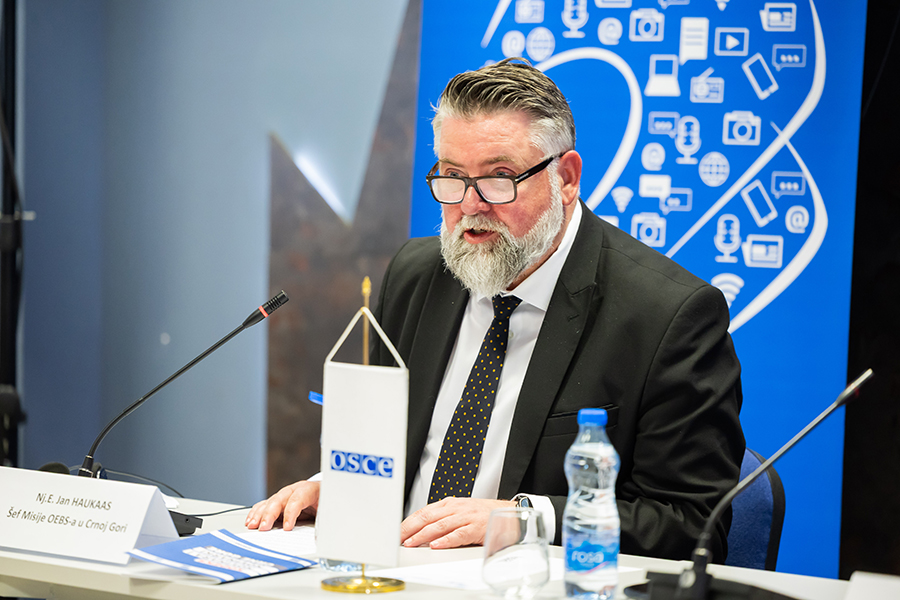
"These amendments represent a significant step in strengthening self-regulation and ensuring that journalistic standards are aligned with the changing realities of the profession, including the use of digital technologies, social media and artificial intelligence. The importance of this work is firmly grounded in OSCE commitments. Member States have recognized that free, independent and pluralistic media are essential to democratic societies, as well as ensuring freedom of expression, transparency and public accountability. Strong systems of media self-regulation complement these commitments by helping to maintain professional standards while preserving editorial integrity. Robust media self-regulation is the most effective first line of defense against misinformation, hate speech, foreign political interference and hybrid threats," Haukaas said.
The updated Code introduces new and more comprehensive provisions on online comments and hate speech, and it improves reporting standards on the right to privacy, political elections, transparency and respect for intellectual property.
"The Code confirms that accuracy, fairness, humanity and truth remain at the core of journalism, while introducing new guidelines on the use of artificial intelligence, behavior on the Internet, the right of reply, transparency and protection of minors and victims. Its successful implementation will depend not only on the commitment of journalists and editors, but also on the understanding and engagement of the general public. That is why the OSCE Mission paid special attention to raising public awareness of self-regulation mechanisms, helping citizens to understand their purpose and importance in preserving ethical and responsible journalism," Haukaas added.
The drafting of the amended Code of Ethics of Journalists was jointly supported by the OSCE Mission in Montenegro, UNESCO and the Council of Europe, and the Code itself is the result of the work of a working group that over the past year worked on the document in a process that included consultations with the media community and civil society organizations with the aim of recognizing different views and achieving the widest possible professional consensus. The Code presented today is a revised version of the 2015 Code.
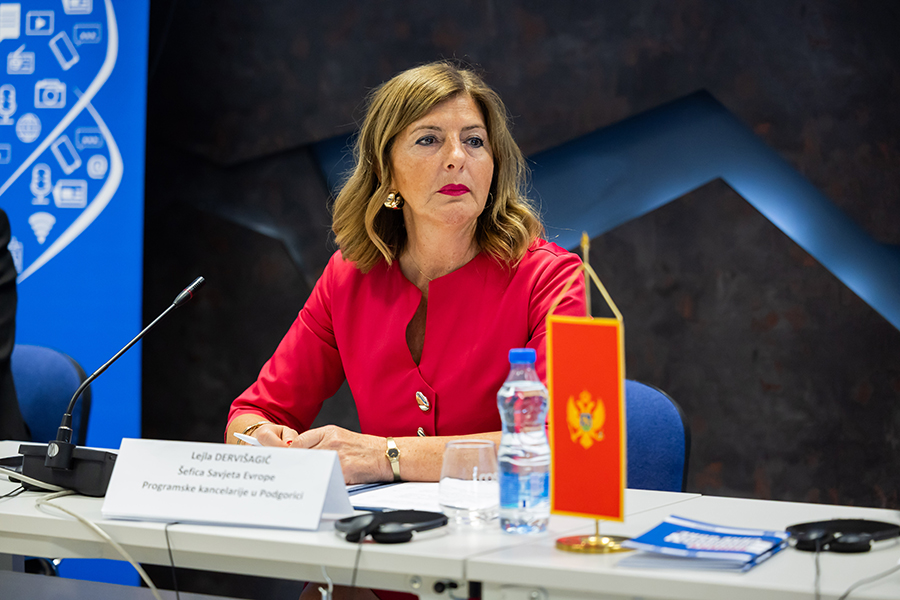
"Since the adoption of the first code, the media environment has changed significantly. Digital transformation, the development of social networks, the ever-present use of artificial intelligence, the rapid spread of disinformation and new forms of hate speech have opened up issues that were not at the forefront ten years ago. That is why it was necessary to revise this Code and adapt it to modern challenges while preserving truthfulness, accuracy, responsibility, professional integrity, independence, respect for human dignity, values that represent the essence of journalistic ethics and remain equally important regardless of the change of technology or the way in which information is distributed or consumed. Thanks to the partnership of all key actors, today we have the Code, which is not only a response to the challenges of modern society, but a document that confirms a common commitment to the highest professional and ethical standards. At a time when public trust in information is seriously shaken, precisely ethics, responsibility and effective self-regulation are one of the most important foundations of quality journalism," said Lejla Dervišagić, Head of the Council of Europe, Program Office in Podgorica.
The representative of UNESCO, Joshua Massarenti, stated that the revision of the Code of Journalists of Montenegro is timely and necessary.
"This revision ensures that the principles of truth, accuracy, fairness, protection of sources, respect for privacy and human dignity remain fully relevant in the digital age. It also provides clearer guidance on issues that are now part of the daily work of journalists and editors, including the use of social networks, online comments, intellectual property, hate speech, courtroom reporting and, crucially, artificial intelligence. UNESCO particularly welcomes the inclusion of provisions on the use of artificial intelligence. The Code makes it clear that content created, shaped or significantly edited by artificial intelligence should be flagged when it could mislead the public. No content generated by artificial intelligence should be published without human verification and approval, and journalists and editors remain fully responsible for what they publish. This is the key message. Artificial intelligence can support journalism, but it cannot replace editorial judgment, professional or human responsibility," said Massarenti.
Speaking about the importance of the Code today, Ranko Vujović, executive secretary of the Media Council for Self-Regulation, pointed out that ethics in the media and freedom of expression are more important today than ever before.
"Initiatives are coming from global and local addresses that everything should be allowed in the media and that freedom of expression must be absolute. These are dangerous initiatives that threaten to collapse professional and ethical journalism and allow the spread of dangerous and illegal content. Freedom of expression is not absolute and the spread of dangerous content must not be allowed. An example of this is the recent ban in Montenegro of a film full of hate speech," Vujović pointed out.
Joan Barata, professor and international media expert spoke of ethical dilemmas, those related to artificial intelligence.
"The Code of Journalists shows sensitivity to this topic and includes certain ethical dilemmas that may arise in direct or indirect connection with artificial intelligence. For example, the Code emphasizes the need for content generated by artificial intelligence - in cases where such use could mislead media users - to be appropriately labeled. It is known that media houses constantly use artificial intelligence, sometimes only for editorial purposes. This does not mean that every content should be labeled, as this would lead to a kind of saturation marks, and the constant presence of such marks could also cause mistrust towards the media. However, I consider the provisions of the Code to be proportionate and reasonable: they require that the mark must be used for content generated by artificial intelligence if that content can mislead users or cause confusion," said Barata.
The novelty of this Code, when it comes to defining the right to privacy, is contained in the fact that it is not only mentioned as part of principle seven Right to privacy, but also in some other principles, so it is also found in guideline 1.5 Use of social networks, in guideline 3.3 Right to be forgotten and in guideline 5.1 Journalistic research.
"We must keep in mind that the right to privacy is an essential prerequisite for freedom, as without privacy there can be no other freedoms. At the same time, it is a prerequisite for other civil rights and at the same time a way to ensure their preservation in practice. The question that arises here is - what are the limits of individual privacy in relation to the obligation, and task of journalists to communicate the truth to the greatest extent possible. This question is immediately followed by another, which are the facts that cannot be published under any circumstances because they encroach on the rights of other persons and their publication would violate the privacy of those persons. In order to prevent this from happening, media ethics established practical criteria for respecting the privacy of the person being reported on, which the journalist is obliged to respect. This is exactly how the right to privacy begins in our code. However, it is not always easy to determine the criteria of privacy in every situation and whether it takes precedence over the public interest. This puts journalists in the unenviable situation of seeking the most ethical solution and balance between the two goods: the public's right to know and protect the rights to privacy," Ilija Jovićević, ombudsman of the daily newspaper Dan, announced at the conference.
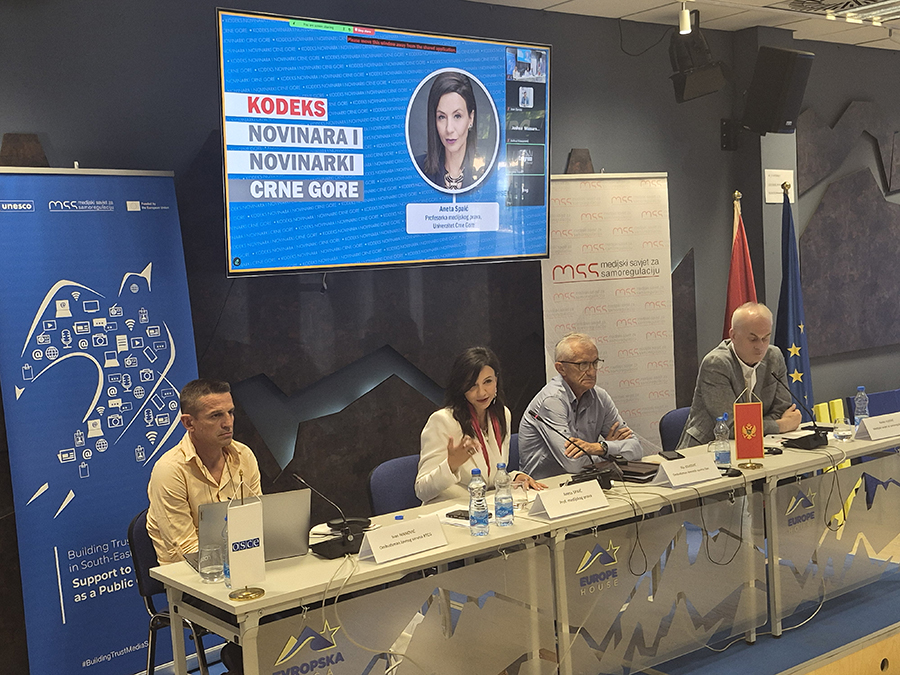
The professor of media law, Aneta Spaić, spoke about how the professional media report on investigations, court proceedings and how they can preserve the basic, constitutional and convention rights stipulated in Article 6 and Article 35 - the right to a fair trial, the right to respect the presumption of innocence, and on the other hand respect for the right to privacy and human dignity.
"Journalists and the media are obliged to respect the presumption of innocence in such a way that they will with particular care and caution publish photos and videos of suspects taken during arrest and detention, which create a perception of guilt and contribute to their stigmatization and public humiliation. Of course, those who report in an impartial, objective and professional manner on what court proceedings are and what they do in the courtroom should not be limited in any way. The basic content of the presumption of innocence is that everyone is innocent until proven otherwise by a final court verdict. This was a segment that we particularly wanted to strengthen through the Code. Especially since, as we have heard, the Law is silent on this matter, and we appeal to the media to be careful about it, so that when a person is acquitted or when a person has obtained a positive outcome of the court proceedings in any other way, it must be published as such. The Code stipulates that a court proceeding must be reported consistently from beginning to end. From the moment when one is suspected until the moment when one’s guilt is established or until the moment when he is acquitted. All phases must be communicated and presented to the public in the same way. What the Code also prescribes is the specificity of protecting the identity of victims of gender-based and sexual violence. Only exceptionally can this identity be revealed, and the same privileged and special status also has the vulnerable category of minors, who must be especially taken care of," said Spaić.
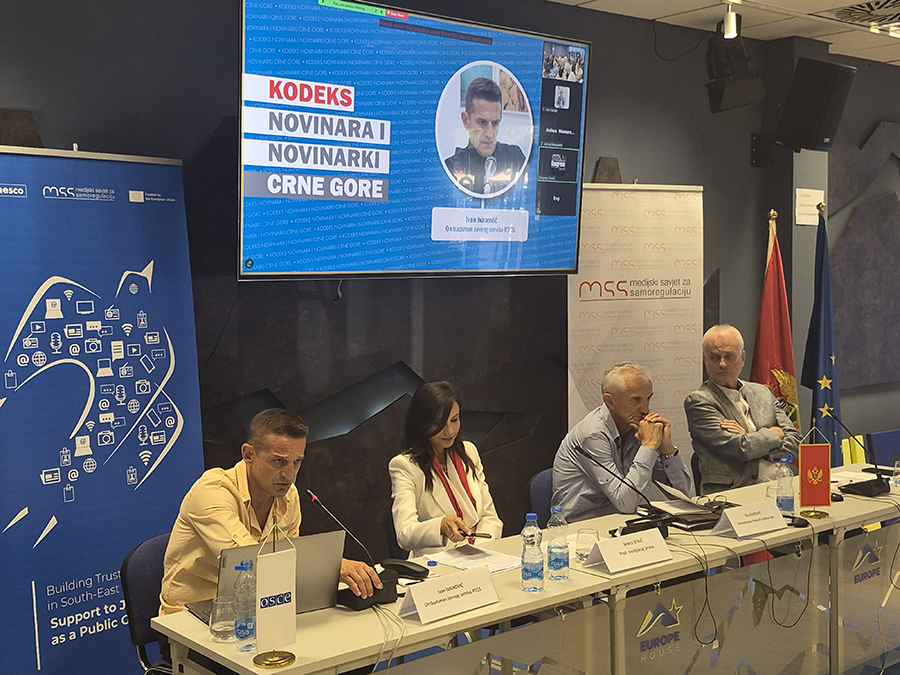
Ivan Ivanović, ombudsman of the public service RTCG, pointed out the importance of the fact that social networks are also included in the Code.
"It is a completely new chapter for self-regulation. Until now, we have not had a way to react to some objections, complaints related to the writing of our journalists on social networks, until now it was somehow a grey area. From today, this grey area will also have to have its own ethical rules of conduct. You should not understand these guidelines as a suppression of freedom of expression, but as an attempt to preserve trust in the journalistic profession. I want to congratulate journalists, first of all, on the new Code of Ethics of Journalists of Montenegro, to read it, to you adhere to the guidelines and principles. That way you will also make job easier for us, the self-regulators," said Ivanović.
The Ethical Code of Journalists of Montenegro was published as part of the UNESCO project, funanced by the European Union, entitled "Building trust in the media in Southeast Europe: Supporting journalism as a public good", which is being implemented in Albania, Bosnia and Herzegovina, Kosovo*, Montenegro, North Macedonia, Serbia and Turkey. The work on the Code was supported by the Council of Europe and the OSCE.
DOWNLOAD Code of Ethics of Journalists of Montenegro in English language
Medijski savjet za samoregulaciju