
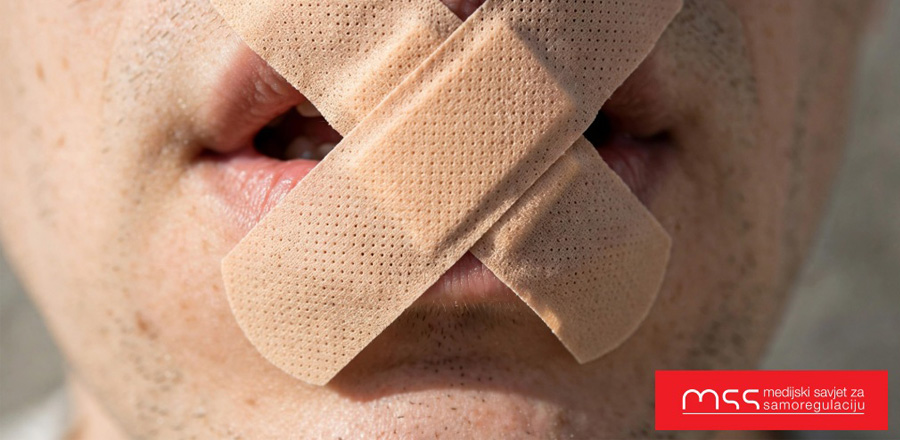
In 2013, the United Nations General Assembly declared November 2nd as the International Day to End Impunity for Crimes Against Journalists. UNESCO is leading this year's campaign under the message "Threats are changing. Impunity remains" and warns that impunity in the world has increased for the first time since 2012, since it has been measured. They indicate that as many as 86% of murders of journalists still do not have a judicial epilogue.
On this occasion, the Media Council for Self-Regulation calls on the prosecutor's office and the courts not to look only at how quickly they will complete the proceedings in cases of attacks and threats to journalists. The punishment should match what was done and must deter anyone who thinks of threatening or attacking a media worker just because of the work they do.
Last year was an infamous record year. The Media Union of Montenegro recorded 33 attacks and pressures on journalists and media workers, and there were twice as many threats via the Internet than the year before. This year, the Union has recorded 18 cases so far. Two received the judicial epilogue. Through the Mechanism for the Safety of Journalists, which has been operating since March, 21 applications have passed through the end of August. There were mostly insults and threats over the Internet, and in one case death threats.
When the process is swift and the punishment small, the message is not much different from that sent by silence. This is best seen in the case of Gornji Zaostra. Photojournalists were attacked while doing their job. Around them was a group of people who threatened them and attacked them. Two people were sentenced in the first instance to six months of house arrest, and the rest of the proceedings were mostly concluded with acquittals. For death threats to Boris Pejović and Balša Rudović, a fine of 300 euros was imposed in the misdemeanor proceedings. If the fine is paid within the deadline, it amounts to only 150 euros. At the same time, in another case, a prison sentence was imposed in the first instance for threats against female journalists. How then can a journalist know what is protecting him, when one threat leads to prison, and a similar one ends with a punishment that resembles a punishment for a traffic violation?
However, the prosecution made progress. With the directive from 2024, cases of attacks on journalists were given priority, and prosecutors were obliged to act without delay and in direct contact with the injured parties. The results are visible. According to the European Commission's Report on the Rule of Law, since July 2025, the prosecutor's office opened 25 cases of threats and violence against journalists, and resolved 18. The Working Group for the establishment of a mechanism for the safety of journalists states in its report that the competent authorities acted within a reasonable time. Precisely because of this, it is not easy to understand why the death threats to two photojournalists ended up before the misdemeanor court, even though the Criminal Code prescribes a stricter punishment for endangering safety when the victim is someone who deals with public information. We expect the Supreme State Prosecutor's Office to explain to the public why this is so. We also expect him to review how threats to journalists are qualified, so that the same threat would not be a criminal offense at one time, and a misdemeanor at another time.
Along with all this, there are also the most difficult cases, which have not received an epilogue for years. Even after 22 years, the murder of Duško Jovanović has not been completely solved, and the perpetrators are still untouchable. The trial for wounding Olivera Lakić, eight years after the attack, is still dealing with the cancellation of attorneys' powers, not evidence. The higher court overturned the first-instance verdict for the attack on Pobjeda journalist Ana Raičković. The retrial began in October and was immediately adjourned until December.
Media Freedom Index, created by the Reporters Without Borders, in 2026 shows that Montenegro fell from 37th to 41st place, assesses the same: most recent attacks have been solved, but the murder of Duško Jovanović and the attempted murder of Olivera Lakić remain without an epilogue. As long as this is the case, progress in recent cases cannot be presented as the end of impunity.
Montenegro is entering the final stages of negotiations with the European Union. The European Commission has been writing for years that the state implements a policy of zero tolerance towards violence against journalists. This should be seen in judgments and not only in announcements. In 2026 Report on the Rule of Law, the European Commission warned that the trial for the attempted murder of a journalist is dragging on and that it is threatened by the statute of limitations. Montenegro, as a candidate country, also supported the statement of the European Union before the Council of Europe from October 30, in which it warns that the absence of responsibility threatens to create a climate of impunity.
A citizen dissatisfied with something published by a media outlet has someone to turn to. These include the right of reply and correction, the courts, media ombudsmen, and the Complaints Commission of the Media Council for Self-Regulation, which adjudicates based on the Code of Ethics of Montenegrin Journalists. Filing a complaint with an ombudsman or the Commission is free of charge, requires no legal counsel, and carries no risk.
Whoever chooses a threat instead of all that, is not looking for correction, but wants to scare the journalist. The state must recognize this difference and punish such threats so that the punishment is visible and deters others.
The Media Council for Self-Regulation is with all colleagues who work under threat this year, as well as those whose cases have been waiting for an answer for years.
Media Council for Self-Regulation